The Wild West of corporate AI roles
1248 words (~8 mins read)
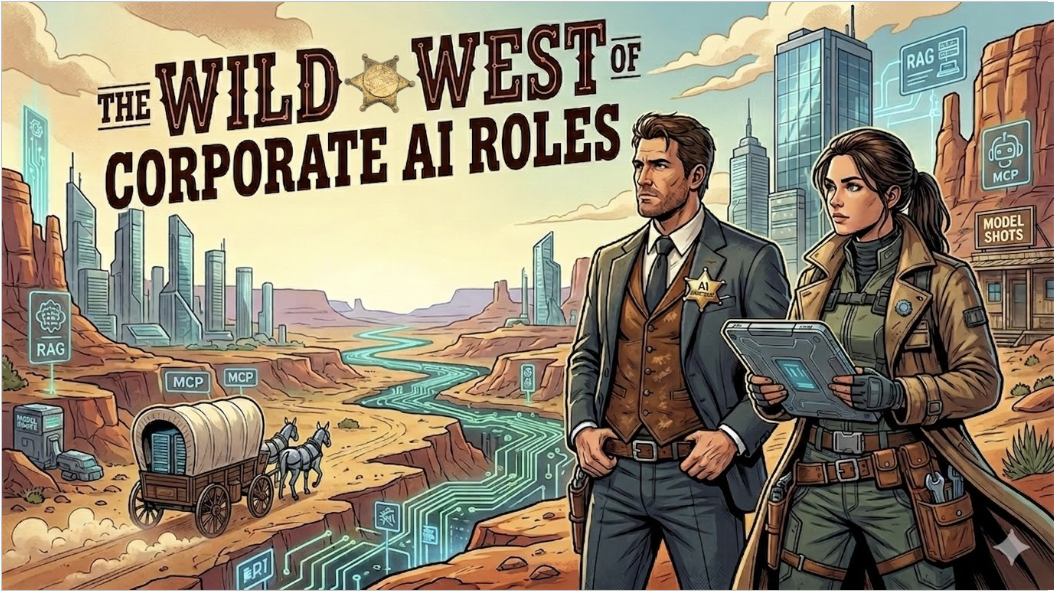
AI continues to change and shape the software industry to this day. Companies are slowly starting to adapt to the new AI landscape in 2026, and many AI-related jobs are starting to pop up. Good news: AI has created new jobs. Bad news: these are mostly roles for seniors (hopefully junior roles will soon make a comeback). Additional bad news: many companies don’t yet know how to correctly define these roles, and many still struggle to understand how AI can bring value to them (if it even can!) and how much it actually costs to build AI stuff.
The AI landscape still feels like the Wild West in many aspects, so let me attempt to briefly describe the most common AI roles we’re seeing on demand right now. This can be useful to know how to position yourself, or to know what kind of person you actually need in your team. This is my POV as someone who has been involved in AI projects in the past 2 years, and who also has several years of experience in the software industry and in consulting.
AI Strategist
Tons of companies and business owners want to introduce AI in their products and business, but they don’t know how. And even if they believe they know what they want, they usually don’t know how much it actually costs to get it. If you have never had an AI specialist in your team or company, or if you have already tried to embed AI into something and been disappointed, please hire an AI strategist.
This is a business-facing role: expect lots of meetings, conversations with stakeholders, (pre-)sales conversations, chasing and keeping up-to-date with AI trends, managing AI-hype and expectations, educating employees and stakeholders about AI, setting budgets, suggesting skillsets and roles to build AI products… This is already a full-time role, and AI strategists are NOT expected to build anything! They simply don’t have time for it! Hence, they don’t necessarily need to come from a technical background. They shouldn’t be tech-illiterate however: without a strong conceptual understanding of data architecture and cloud systems they risk falling for vendor snake oil. AI strategists are experienced in working with teams of AI engineers, defining requirements for AI products, communicating constantly with stakeholders, and managing expectations. This is a very similar role to that of a Product Owner in the well-known Scrum framework.
AI Engineer
AI engineers can also be described as AI developers or AI software engineers. FWIW this is my current role. They are software engineers specialized in building and maintaining AI systems. They know what LLMs are from a theoretical PoV, their strengths and limitations, and they know how to develop and build systems that leverage existing AI models (colloquially, you can call these systems “ChatGPT wrappers”). They know AI paradigms and architectures like Retrieval-Augmented Generation (RAG), Model Context Protocol (MCP), AI agents… They know how to build AI tools and apps, scale them for enterprise and production use, secure them, and maintain them. They bring their full-stack and backend development skills and fit all the Lego pieces together to make sure your AI system runs smoothly.
Don’t expect an AI engineer to be an AI strategist or an ML engineer (see below). Some people can do any of these roles, but if you expect them to be an AI strategist and an AI engineer at the same time, they’re not going to be able to deliver very well. Choose one or the other role at a given time. Or hire one of each. Just as you would hire a software engineer to build stuff and not to sit in meetings the whole day, don’t hire an AI engineer to sit the whole day in meetings concerning AI. They won’t have time to build what you asked.
Difference between ML and AI engineers
Before the irruption of LLMs and Generative AI three years ago, the concept of “AI engineer” was drastically different than nowadays. AI engineers back then were the ones who built AI models from scratch, trained them with data, fine-tuned them, implemented ML algorithms… They did what is currently known as “traditional AI”. Nowadays these are known as “ML engineers”, and the distinction should be clear. Many job postings are still listing “ML/AI Engineer”, or “AI Engineer” with knowledge requirements for traditional AI. Sometimes they ask for a PhD in ML/AI. Make sure you clarify whether the role is for an ML or an AI engineer, because not everyone can do both. People with PhDs in ML/AI often lean more toward research and experimentation rather than enterprise software engineering, meaning they might need a strong software engineer by their side to scale their work. AI engineers can build the scalable software surrounding AI, but they might struggle to train and fine-tune AI models.
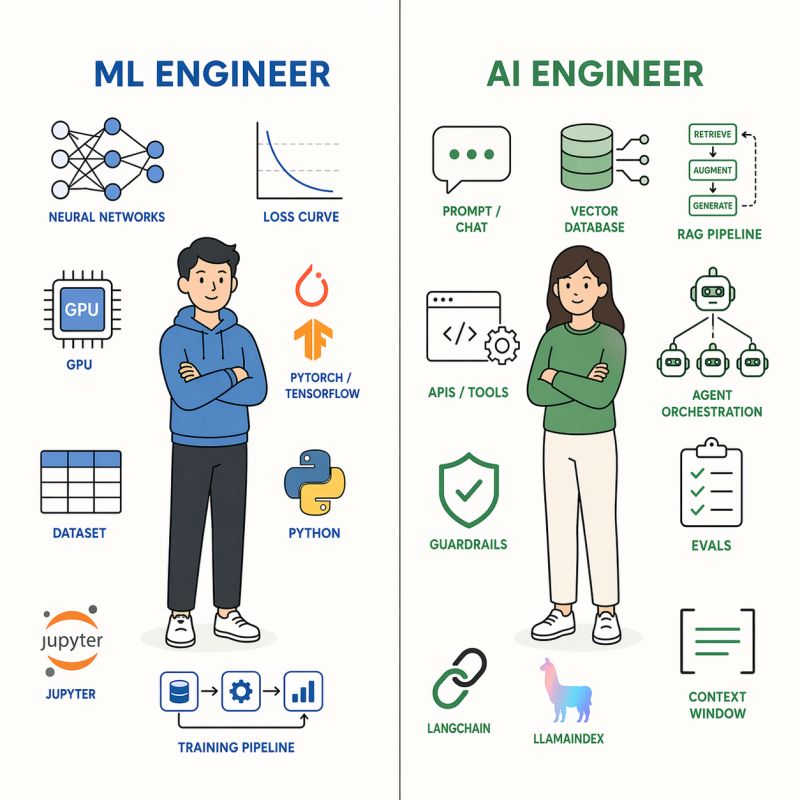
Image source: this LinkedIn post by Louis-François Bouchard
AI Lead
Instead of hiring a lonely AI engineer and burden them with tons of responsibility, it’s usually a good idea to hire multiple AI engineers and create an AI team. One of those engineers, maybe the most senior, could then be the AI lead. They have the last word on architectural decisions, and they usually spend more time reviewing code and coordinating team efforts than actually coding or building. This is a common pattern in software development teams (one engineer is usually the dev lead).
Other AI Roles
- LLMOps engineer, MLOps engineer, Whatever-AI-Ops engineer: These are to AI engineering what DevOps engineers are to software engineers. They are in charge of AI operations: CI/CD pipelines, infrastructure to support the AI systems, setting up monitoring and observability frameworks… These are technical roles that can blend with AI engineers in the same way that DevOps blends with software engineering.
- AI designer: UI/UX designers specialized in AI products. AI products are software products and they also need intuitive and user-friendly UIs.
- AI consultant: If you’re in consulting, you can very well be an AI consulting. You might need to wear several different hats for different AI roles we have covered here, depending on what your client needs. For your sanity, insist in wearing only one hat at a time, or bad things will happen. If you’ve been a software consultant, you’ll understand how you might need to be a frontend developer, DevOps engineer, or a Scrum Master depending on your client needs. Just don’t be all at once!
Wrap-Up
| Role | Primary Focus | Core Skillset | Technical Depth |
|---|---|---|---|
| AI Strategist | ROI, business value, expectation management | Product management, AI trends, budgeting | Low to Medium (Conceptual) |
| AI Engineer | App integration, pipelines, scaling models | Full-stack/Backend, RAG, MCP, API usage | High (Software Dev) |
| ML Engineer | Model creation, fine-tuning, training | Mathematics, data science, deep learning | High (Data/Research) |
This is by no means set in stone. These roles will surely continue evolving, and AI will continue to create jobs (hopefully some entry-level ones for those junior graduates!). It’s also interesting to see how the big AI vendors adapt their offering in 2026, since it’s well-known that they’re running at big losses and won’t be able to be generous any more in the near future. I suspect that those engineers who can be both effective and efficient in their AI usage will be in high demand soon. Cost-efficiency and token-optimization are the next big survival skills for AI engineers.
Did I miss an AI-related role that should have been in this article? Any description disagreements? Reach out to me in whatever social media platform I’m in and let’s talk!
Was this blog post helpful or relatable? Let's talk about it! Send me an email to contact(at)christiangreciano.com and I'll love to interact with you, since I'm always looking for meaningful conversations.