Still trusting Notion with your data?
715 words (~5 mins read)
Photo by Gwyn Hay on Unsplash (I added Notion logo and file icons)
A couple of days ago a Reddit user described a horror story where they lost tons of important data in Notion. Their Reddit post got a lot of traction and attention. It is just another reminder that we should care on where we store our important data, and who we entrust that data with. Cloud storage and cloud syncing are really convenient, but what if something goes wrong? Do you have a local backup of your most important data, files, and documents?
Disappointed with Notion
I came across Notion several years ago and I was stunned. A very easy UI to get started in, an opinionated formatting that simplifies workflow, and easy keyboard shortcuts for efficiency. Free to use, powerful, free and automatic sync between devices... Amazing product! And it must be doing something right, because its revenue continues to grow and grow with time.
However, for me Notion is a beautiful note-taking app with some useful database functionality, and THAT'S IT. I don't believe it's a good task manager nor a good productivity command center, despite what many Notion influencers might try to sell you. If it's trying to compete with Microsoft 365 and Google Workspaces... it falls tremendously short at that. It has shoe-horned its AI to all its users, mostly slowing down loading times without bringing that much value.
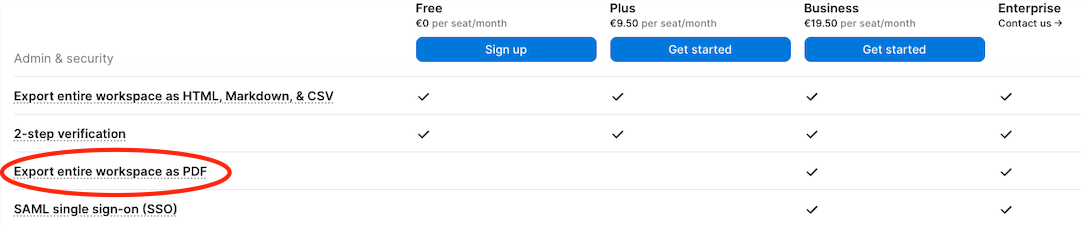
Yes, loading times, a consequence of Notion's biggest flaw in my opinion: your data is not local, it's stored in their online servers. You can't access Notion files in your device, and downloading your data in a different format is clunky: you can download your Notion pages as HTML, CSV, and Markdown for free (with limitations), but exporting your whole workspace as PDFs (the most convenient format for documents and printing) requires a Notion Business subscription. Notion introduced an offline mode a while ago, and it helps with loading times, but you still can't access local files nor easily migrate to other note-taking apps.
Obsidian is local-first
The online nature of Notion made me look into Obsidian. Obsidian's UI and out-of-the-box workflows are not as sexy as Notion's, but it's actually not that difficult to use (in essence, Obsidian is an enhanced text editor at its core). I can also see all my Obsidian data as Markdown files in my computer. I can easily migrate to another app if Obsidian stops being supported or something better comes along. I see my data. I control my data. I own my data. The convenience of cloud sync across devices is not free in Obsidian: you either pay a subscription to use their servers, or you set up your own synchronization across devices. It's a trade-off I'm willing to accept.
I still use both Obsidian and Notion
Oftentimes Obsidian and Notion are pitched as competitors and for many use cases they are indeed competitors ("which is the best note-taking app?"). Myself, I use Obsidian much more than Notion these days: I use Obsidian for journaling, brainstorming, content creation, personal note taking... I still use Notion to create study notes that I want to share publicly though. Notion's feature to create ad-hoc and free websites from any Notion page is super handy! But I fully understand that Notion could take my data hostage for whatever reason at some point. If that happens, however, I have PDF exports of my online Notion notes, so it wouldn't be the end of the world. It is a bit of a pain having to pay the Notion Business subscription just to download PDF files of my study notes (and I also have to stitch the PDFs together into one larger PDF file), but I do get to offset that by selling my notes in PDF format (users who want to use my study notes for free can always study from the online notes in Notion).
Learn the data ownership lesson
If a product is wonderful, convenient, and free, investigate how they make their revenue. Understand the trade-offs involved compared to its competitors. Decide what you can and can't live without. Be conscious about it, or you might live a nightmare scenario at some point. I myself can't accept lots of important data not being available locally.